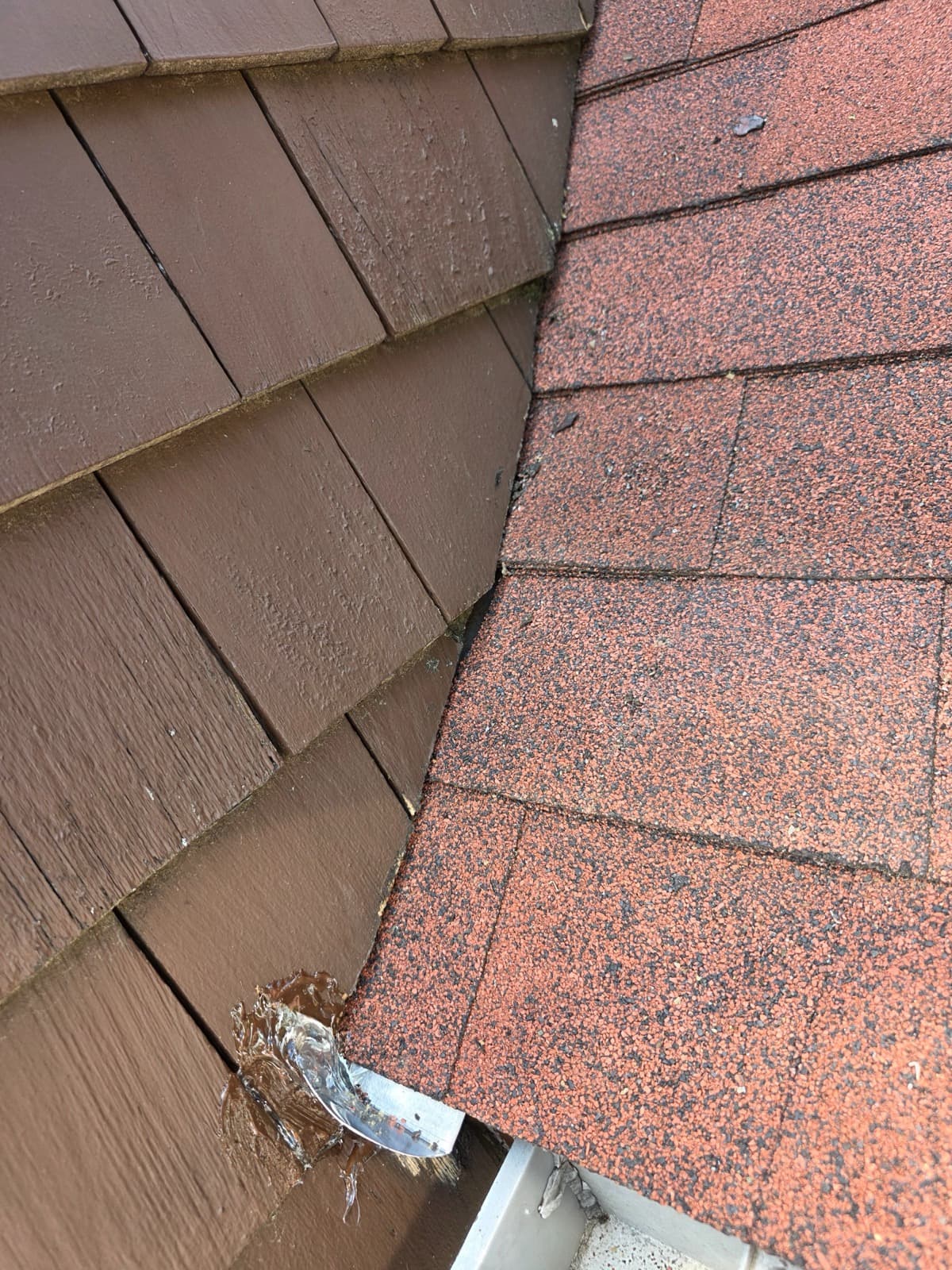
If water is showing up near a chimney, wall, skylight, vent pipe, dormer, or roof valley, the problem may not be your shingles. It may be the flashing.
Roof flashing is the metal or waterproof transition material that moves water away from the weak spots in your roof system. When it rusts, lifts, cracks, pulls away from brick, or was installed incorrectly, water can get behind it and travel into your attic or ceiling.
For Connecticut homes, flashing roof repair matters because our roofs deal with wind-driven rain, freeze-thaw cycles, snow melt, ice, and fast temperature swings. A tiny gap around a chimney or pipe boot can become a ceiling stain after the next storm.
Trust Proof Roofing handles roof flashing repairs across Connecticut as part of our roof repair services. We are licensed in Connecticut under CT HIC #HIC.0703927, and every repair includes a 1-year leak-proof warranty on the repaired area.
Short answer: can roof flashing be repaired?
Yes, roof flashing can often be repaired if the damage is limited to a small section, loose edge, failed sealant, minor rust hole, or pipe boot issue.
But flashing should not always be patched. If the metal is badly corroded, the shingles around it are failing, the chimney mortar is deteriorated, or the flashing was installed in the wrong sequence, the better repair is usually to remove and replace the affected flashing assembly.
A proper flashing repair is not just “add caulk.” Sealant can help in specific places, but flashing is supposed to shed water mechanically. The metal, shingles, underlayment, and wall or chimney connection all need to work together.
What roof flashing does
Flashing protects the places where water naturally tries to enter your roof. These areas include:
- Chimneys
- Skylights
- Vent pipes
- Plumbing boots
- Dormers
- Sidewalls
- Headwalls
- Valleys
- Roof edges
- Areas where a lower roof meets a wall
Shingles are designed to shed water across open roof slopes. Flashing protects the interruptions.
Think of it this way: shingles handle the field of the roof. Flashing handles the seams.
Signs you may need flashing roof repair
You may have a flashing problem if you notice any of these:
- Brown or yellow ceiling stains near a chimney, bathroom, kitchen, or exterior wall
- Drips during wind-driven rain, but not every storm
- Wet insulation in the attic near a roof penetration
- Rusted, bent, or missing metal around the chimney or wall
- Cracked rubber around a vent pipe
- Loose counterflashing at brick or stone
- Gaps where the roof meets siding
- Shingles lifting near a wall or skylight
- Moldy odor in an upstairs room after rain
- Water stains that appear after snow or ice melts
One important note: the visible stain is not always directly below the leak. Water can run along rafters, decking, wiring, or insulation before it shows up inside.
The most common flashing leak points
Chimney flashing
Chimneys are one of the most common flashing leak areas. A proper chimney flashing system usually includes step flashing along the sides, base flashing at the bottom, counterflashing cut into the masonry, and sometimes a cricket or saddle on the uphill side.
Common problems include failed sealant, loose counterflashing, cracked mortar joints, rusted metal, or missing kick-out details where water should be directed away.
Step flashing at walls and dormers
Step flashing is installed in overlapping pieces where shingles meet a vertical wall. Each shingle course gets its own piece of flashing.
If step flashing is missing, reused incorrectly, nailed in the wrong place, or buried behind siding without proper clearance, water can sneak behind the roof edge and enter the wall.
Flashing work and the finished junction
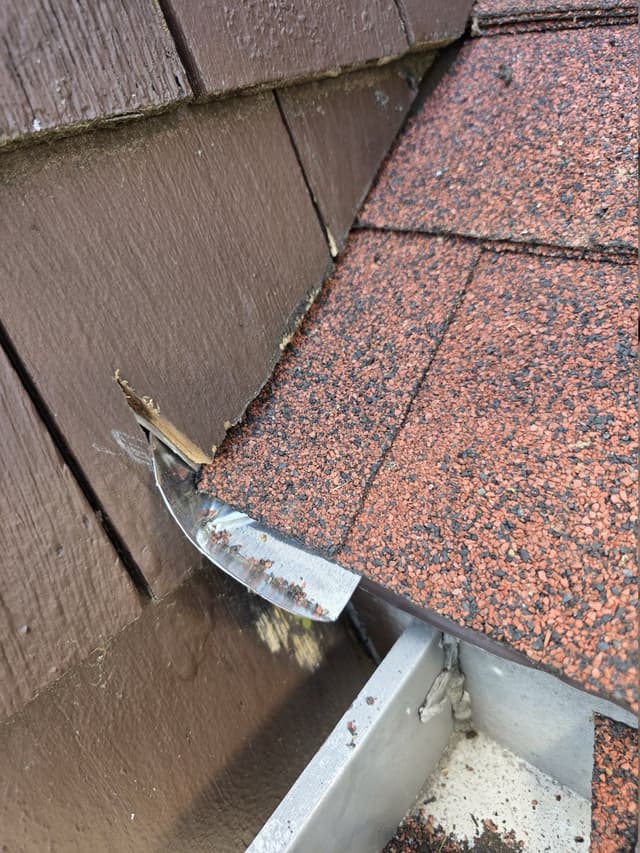
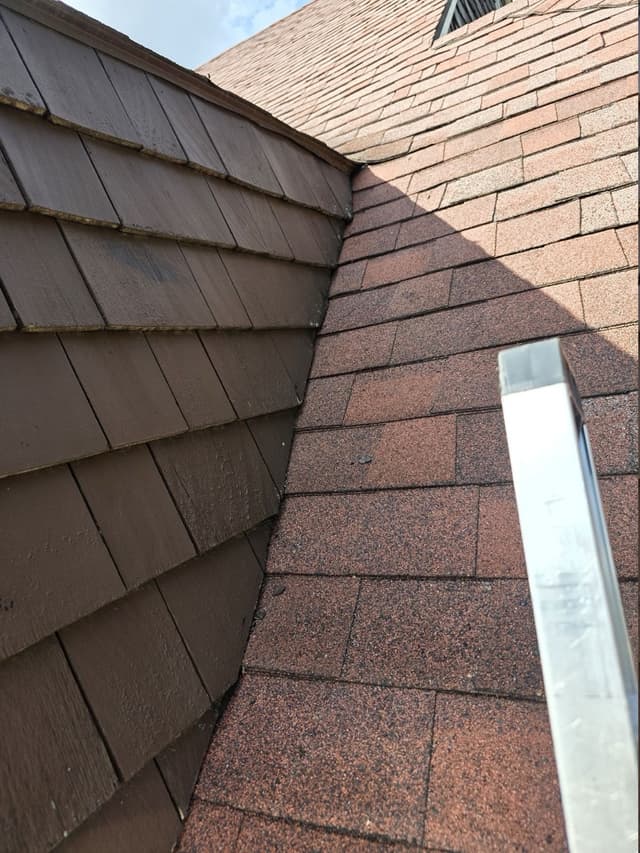
Work and finished views from the same documented New Britain, Connecticut roof-to-wall repair. Project locations are stated only where verified; other-town photographs illustrate the repair topic.
Vent pipe flashing and pipe boots
Pipe boots use rubber or flexible material around plumbing vent pipes. Over time, the rubber can split from UV exposure and temperature movement. This creates a direct path for water around the pipe.
A small pipe boot leak can look like a major roof issue because water may follow the pipe down into a ceiling or wall cavity.
Skylight flashing
Skylights need a full flashing kit or properly integrated custom flashing. Leaks may come from the skylight itself, the flashing, surrounding shingles, or condensation. The repair depends on the source.
Valley flashing
Valleys carry a high volume of water. If valley metal is damaged, clogged, installed too flat, or cut poorly, water can back up under shingles.
Drip edge and roof edge flashing
Drip edge helps direct water off the roof edge and into the gutter. If it is missing or misaligned, water can curl behind the fascia, stain soffits, rot roof edges, or create gutter-related leaks.
What causes roof flashing to fail?
Flashing usually fails for one of five reasons.
1. Age and corrosion
Metal flashing can rust, pit, or weaken over time. Connecticut’s wet seasons, snow, and freeze-thaw cycles can speed up deterioration, especially if water sits against the metal.
2. Movement
Roofs expand and contract. Chimneys, walls, skylights, and vent pipes move differently from shingles and decking. That movement can crack sealant, loosen fasteners, or open gaps.
3. Storm damage
High wind, heavy rain, fallen branches, and ice can lift or bend flashing. Connecticut homeowners can verify storm history through the NOAA Storm Events Database.
4. Incorrect installation
Flashing has to be layered in the right order. If the shingle, underlayment, and flashing sequence is wrong, water can be directed into the roof instead of away from it.
5. Over-reliance on caulk
Sealant is not a substitute for properly installed flashing. If a leak has been “fixed” several times with more caulk, the underlying flashing detail may still be wrong.
Flashing repair vs. flashing replacement
Not every flashing issue needs the same fix. The right repair depends on the condition of the flashing, surrounding shingles, decking, wall, and roof penetration.
| Situation | Likely solution | |---|---| | Small exposed nail hole or minor gap | Seal and reinforce the affected area | | Split pipe boot rubber | Replace the boot or install an approved repair boot | | Loose counterflashing | Re-secure and seal, if the metal and masonry are sound | | Rusted flashing with holes | Replace the damaged flashing section | | Missing step flashing | Remove affected shingles and install proper step flashing | | Chimney flashing installed incorrectly | Rebuild the flashing assembly | | Soft decking around the leak | Repair damaged roof decking before closing the roof | | Widespread roof wear near flashing | Evaluate whether repair or replacement makes more sense |
The key is finding the actual water entry point before deciding on the repair.
Can you repair roof flashing yourself?
Some homeowners can handle very minor temporary sealing from the ground or from a safe, low-slope access point. But most flashing repairs involve roof work, ladders, tools, and fall risk.
Falls are one of the major hazards in construction, and roof work should be treated seriously. OSHA publishes homeowner-relevant fall hazard information through its Fall Protection in Construction resources.
You should call a roofer if:
- The roof is steep, high, wet, icy, or difficult to access
- The leak is near a chimney, skylight, valley, or dormer
- You see interior staining but cannot identify the source
- Flashing is missing, rusted through, or pulled away
- Shingles need to be removed to access the flashing
- The roof is older and multiple areas are failing
A tube of sealant may slow water temporarily, but it can also hide the real issue and make the next repair harder to diagnose.
What a proper flashing roof repair should include
A good flashing repair should be more than a quick look from the driveway. At minimum, the roofer should identify the leak area, inspect the surrounding roof, document what they find, and explain the repair clearly.
At Trust Proof Roofing, the repair process is built around proof. You should be able to see what is wrong before you approve the work.
A proper flashing repair may include:
- Inspecting the leak area from the roof and, when possible, the attic
- Checking nearby shingles, underlayment, decking, siding, masonry, or pipe boots
- Photographing the damaged area
- Explaining whether the flashing can be repaired or should be replaced
- Removing damaged shingles or old sealant where needed
- Installing or resetting the correct flashing detail
- Sealing only where sealant belongs
- Replacing affected shingles or materials
- Testing or documenting the completed repair
- Providing completion photos
That documentation matters. If a repair is only described verbally, you are left guessing what was actually done.
How much does flashing roof repair cost in Connecticut?
Flashing roof repair cost depends on the roof height, pitch, access, material, leak location, and whether shingles or decking need to be removed.
Trust Proof Roofing’s public roof repair tiers are:
| Repair type | Typical range | |---|---:| | Small repair | $400–$600 | | Big repair | $800–$1,300 |
For comparison, Angi’s 2026 roof leak repair benchmark lists $700–$3,000, with a median of $900. Get an instant quote
Flashing repairs near a simple pipe boot usually fall on the smaller side. Chimney, skylight, wall, or valley flashing repairs can be more involved because the surrounding shingles, masonry, siding, or decking may need attention.
We do not recommend choosing a flashing repair based only on the lowest number. The important question is: what exactly is included, and will you receive photos showing the problem and the completed repair?
When flashing damage means you may need a roof replacement
Flashing damage alone does not mean you need a new roof. Many flashing leaks are repairable.
But replacement may be worth discussing if:
- The roof is near the end of its useful life
- Shingles are brittle, curling, missing, or losing granules
- Multiple flashing areas are leaking
- The decking is soft in several places
- Old flashing was reused during a previous roof installation
- Ice or water has damaged a large roof area
- Repairs are becoming frequent
If the roof system is still in good condition, a focused repair may make sense. If the roof is failing in multiple areas, a repair may only buy a little time.
Trust Proof Roofing handles both roof repairs and roof replacement, so the recommendation should be based on the condition of your roof, not on forcing one option.
What to ask before hiring someone for flashing repair
Before you approve flashing work, ask:
- Where exactly is the leak entering?
- Is the flashing damaged, missing, loose, or installed incorrectly?
- Will shingles need to be removed?
- Is the decking solid?
- Are there photos of the problem area?
- What materials will be used?
- What area is covered by the repair warranty?
- Will I receive completion photos?
- Is the contractor licensed in Connecticut?
You can verify home improvement contractor licensing through the Connecticut eLicense lookup. Trust Proof Roofing is listed under CT HIC #HIC.0703927.
What you should see in a flashing repair proposal
A clear flashing repair proposal should include:
- The specific leak location
- The suspected or confirmed cause
- The repair scope
- Materials being replaced or reset
- Any exclusions, such as masonry rebuilding or interior drywall repair
- Photos, when available
- Price range or written price
- Warranty terms for the repaired area
For Trust Proof Roofing repair work, the repaired area receives a 1-year leak-proof warranty against installation defects, including leaks, from completion.
Get proof before you approve the repair
Flashing leaks are frustrating because they can be hard to trace from inside the house. The right roofer should not ask you to guess. You should see photos, a clear scope, and a written repair plan.
If you are seeing stains near a chimney, skylight, wall, vent pipe, or roof valley, start with documentation.
Get an instant quote or contact Tenzin to book an inspection.
Flashing work is standard repair territory for us: see flashing repair, published pricing on the cost page, and how to vet any CT roofing contractor first.